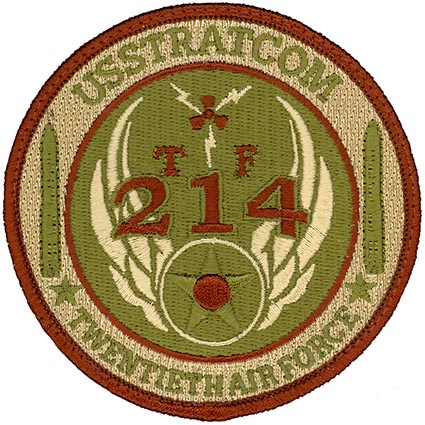
Description
Computer made/mounted on velcro 3.5 inch-90mm
TASK FORCE 214 – LAND-BASED INTERCONTINENTAL BALLISTIC MISSILES
TF-214 Mission in Support of USSTRATCOM
Perform credible, around-the-clock nuclear deterrence operations; when directed by the President of the United States, conduct rapid, accurate, and decisive global ICBM strike.
Designated as STRATCOM’s Task Force 214, 20th Air Force has dual responsibilities to Air Force Global Strike Command and USSTRATCOM. This task force provides the President of the United States with quick-reacting and highly reliable strategic missile forces.
These forces are dispersed in hardened silos across the nation’s central tier and are based at F.E. Warren Air Force Base, WY., Malmstrom Air Force Base, MT. and Minot Air Force Base, N.D.
TWENTIETH AIR FORCE (AIR FORCES STRATEGIC) (AFGSC)
Lineage. Established as Twentieth Air Force and activated on 4 Apr 1944. Inactivated on 1 Mar 1955. Activated on 1 Sep 1991. Redesignated as Twentieth Air Force (Air Forces Strategic) on 1 Dec 2009.
Assignments. Army Air Forces, 4 Apr 1944; United States Army Strategic Air Forces, 16 Jul 1945; Pacific Air Command, United States Army (later Far East Air Forces), 6 Dec 1945-1 Mar 1955. Strategic Air Command, 1 Sep 1991; Air Combat Command, 1 Jun 1992; Air Force Space Command, 1 Jul 1993; Air Force Global Strike Command, 1 Dec 2009-.
Major Components. Commands: VII Fighter, 5 Aug 1945-c. Aug 1946. XX Bomber, 19 Apr 1944-18 Jul 1945. XXI Bomber, 9 Nov 1944-18 Jul 1945. Wings: 18 Fighter-Bomber, 10 Nov 1954-31 Jan 1955. 19 Bombardment, 17 Aug 1948-16 May 1949, 17 Oct 1949-11 Jun 1954 (detached 1 Jun 1953-c. 28 May 1954). 23 Fighter, 16 Aug 1948-25 Apr 1949. 44 Missile, 1 Sep 1991-5 Jul 1994. 51 Fighter, 16 May 1949-1 Mar 1955 (detached 25 Sep-12 Oct 1950). 58 Bombardment, 29 Jun-12 Oct 1944; 1 Feb-15 Nov 1945. 73 Bombardment, c. 6 Aug-9 Nov 1944. 90 Missile (later, 90 Space), 1 Sep 1991-. 91 Missile (later, 91 Missile Group; 91 Missile Wing; 91 Space Wing, 91 Missile Wing); 1 Sep 1991-. 98 Bombardment (Attached 18 Jun-25 Jul 1954). 301 Fighter, 21 May 1945-14 Aug 1945 (detached 21 May 1945-14 Aug 1945). 307 Bombardment (Attached 18 Jun-19 Nov 1954). 310 Training and Test, 1 Sep 1991-1 Jul 1993. 313 Bombardment, 16 Jul 1945-13 Mar 1946. 314 Bombardment, 16 Jul 1945-15 May 1946. 315 Bombardment, 16 Jul 1945-30 May 1946. 321 Missile (later, 321 Missile Group), 1 Sep 1991-2 Jul 1998. 341 Missile (later, 341 Space), 1 Sep 1991-. 351 Missile, 1 Sep 1991-31 Jul 1995. 374 Troop Carrier, (Attached 17 Aug 1948-5 Mar 1949).
Stations. Washington, DC, 4 Apr 1944; Harmon Field (later Harmon AFB), Guam, 16 Jul 1945; Kadena AFB (later Kadena AB), Okinawa, 16 May 1949-1 Mar 1955. Vandenberg AFB, CA, 1 Sep 1991; Francis E. Warren AFB, WY, 1 Oct 1993-.
Operations. After the activation of Twentieth Air Force in Apr 1944, some combat units moved from the United States to India and onto forward bases in China by summer to conduct heavy bombardment operations with B-29 Superfortresses against targets in Japan, Formosa, Thailand, and Burma during Operation MATTERHORN. Other combat elements moved in late 1944 from the United States to the Marianas, where they were joined in early 1945 by the elements that had been in India and China. Headquarters, Twentieth Air Force moved to Guam on 16 Jul 1945. From Guam, Saipan, and Tinian, the Twentieth conducted a strategic air offensive against Japan, climaxed by the dropping of two atomic bombs, one each on Hiroshima and Nagasaki, which led to the Japanese surrender, ending World War II. After the war, the Twentieth remained in the theater. Elements served in combat for a short time at the beginning of the Korean War, but Twentieth AF later was concerned primarily with logistics support for the operations of other organizations and with providing air defense of the Ryukyu Islands. Inactivated in Okinawa on 1 Mar 1955. Activated again in 1991 to maintain and operate the Air Force’s intercontinental ballistic missile (ICBM) forces, first under Strategic Air Command, then (1992) under Air Combat Command, later (1993) under Air Force Space Command, and finally (2009) under Air Force Global Strike Command (the former Strategic Air Command).
Service Streamers. World War II: American Theater; Asiatic-Pacific Theater; Korea: Korean Service.
Campaign Streamers. None.
Armed Forces Expeditionary Streamers. None.
Decorations. Air Force Outstanding Unit Awards: 1 Sep 1991-31 Aug 1993; 1 Sep 1993-14 Oct 1994; 1 Oct 1995-30 Sep 1997; 1 Oct 1997-30 Sep 1999; 1 Oct 1999-30 Sep 2001; 1 Oct 2001-30 Sep 2003; 1 Oct 2005-30 Sep 2007.
Emblem. Approved on 26 May 1944, modified on 15 Oct 1991 and 18 May 1994.
UNITED STATES STRATEGIC COMMAND
U.S. Strategic Command is one of eleven unified combatant commands in the Department of War, stationed at Offutt AFB, NE.
USSTRATCOM integrates and coordinates the necessary command and control capability to provide support with the most accurate and timely information for the President, the Secretary of War, other national leadership and combatant commanders.
The mission of USSTRATCOM is to conduct operations to deter strategic attack and employ forces, as directed, to guarantee the security of the nation and our allies. The command enables Joint Force operations and is the combatant command responsible for Strategic Deterrence, Nuclear Operations, Nuclear Command, Control, and Communications (NC3) Enterprise Operations, Joint Electromagnetic Spectrum Operations, Global Strike and Missile Threat Assessment.
USSTRATCOM combines the synergy of the U.S. legacy nuclear command and control mission with responsibility for global strike operations. This dynamic command gives national leadership a unified resource for greater understanding of specific threats around the world and the means to respond to those threats rapidly.
The Global Operations Center, or GOC, is the nerve center for USSTRATCOM. The GOC is responsible for the global situational awareness of the Commander, USSTRATCOM, and is the mechanism by which he exercises operational command and control of the Nation’s global strategic forces.
The missions of U.S. Strategic Command are to deter attacks on U.S. vital interests, to ensure U.S. freedom of action in space and cyberspace, to deliver integrated kinetic and non-kinetic effects to include nuclear and information operations in support of U.S. Joint Force Commander operations, to synchronize global missile defense plans and operations, to synchronize regional combating of weapons of mass destruction plans, to provide integrated surveillance and reconnaissance allocation recommendations to the SECDEF, and to advocate for capabilities as assigned.
Component Structure: JFCC – Global Strike (JFCC-GS) Offutt AFB, NE, conducts kinetic (nuclear and conventional) and non-kinetic effects planning. GS manages global force activities to assure allies and to deter and dissuade actions detrimental to the United States and its global interests; should deterrence fail, employs global strike forces in support of combatant commander.
JFCC – Space (JFCC-SPACE) Vandenberg AFB, CA, continuously coordinates, plans, integrates, commands and controls space operations to provide tailored, responsive, local and global effects, and on order, denies the enemy the same, in support of national, USSTRATCOM, and combatant commander objectives.
JFCC – Network Warfare (JFCC-NW) Fort Meade, MD, plans, and when directed, executes operations in and through cyberspace to assure US and allied freedom of action, denying adversaries’ freedom of action, and enabling effects beyond the cyber domain.
Joint Task Force-Global Network Operations (JTF-GNO) Arlington, VA, directs the operation and defense of the Global Information Grid to assure timely and secure Net-Centric capabilities across strategic, operational, and tactical boundaries in support of Department of Defense full spectrum warfighting, intelligence, and business missions.
JFCC – Integrated Missile Defense (JFCC-IMD) Schriever AFB, CO, synchronizes operational-level global missile defense planning, operations support, and the development of missile defense effects for DoD. When directed, also provides alternate missile defense execution support.
JFCC – Intelligence, Surveillance and Reconnaissance (JFCC-ISR) Bolling AFB, Washington, D.C. identifies and recommends appropriate resources to meet high priority intelligence requirements. Essentially, ISR helps ensure the best use of resources to provide decision makers and troops with crucial information when and where they need.
Joint Information Operations Warfare Command (JIOWC) Lackland AFB, TX, uses information as a tool to change attitudes or perceptions, creating desired results. Information Operations tactics help protect United States interests while disrupting the adversary’s capabilities.
USSTRATCOM Center for Combating Weapons of Mass Destruction (SCC-WMD) Fort Belvoir, VA, provides the Defense Department with expertise in contingency and crisis planning to interdict and eliminate the proliferation or use of Weapons of Mass Destruction.