Description
Computer made/NOT mounted on velcro 4.0 inch-100mm
E-6B AIRBORNE COMMAND POST (ABNCP)
Mission. A mark of America’s strategic excellence is its preeminent ability to command, control, and communicate with its nuclear forces. An essential element of that ability is U.S. Strategic Command’s Airborne Command Post, also called “Looking Glass. ” Its highly-trained crew and staff ensure there is always an aircraft ready to direct bombers and missiles from the air should ground-based command centers become inoperable. Looking Glass guarantees that U.S. strategic forces will act only in the precise manner dictated by the president.
The now-deactivated Strategic Air Command began the mission on February 3, 1961. It took the nickname Looking Glass because the mission mirrored ground-based command, control, and communications. From that date, an Air Force EC-135 Looking Glass aircraft was in the air at all times 24 hours a day, 365 days a year for more than 29 years. On July 24, 1990, Looking Glass ceased continuous airborne alert, but remained on ground or airborne alert 24 hours a day. Crews accumulated more than 281,000 accident-free flying hours, an aviation phenomenon. On Oct. 1, 1998, the Navy’s E-6B Mercury replaced the EC-135 in the Looking Glass mission.
The E-6B is a Boeing 707 airframe loaded with high-tech communication equipment. The E-6B has the ability to communicate directly with the nation’s ballistic submarine fleet. Its battle staff, when airborne, is under the command of a flag officer — an Air Force general officer or a Navy admiral. General and flag officers are from USSTRATCOM, Joint Functional Component Command-Global Strike (JFCC-GS), the United State Air Force’s Air Force Global Strike Command (AFGSC), Air Mobility Command (AMC), Air Combat Command (ACC), Air Force Space Command (AFSPC), Air Force Reserve Command (AFRC), and the Air National Guard (ANG), the Navy’s Commander Submarine Group NINE, Pacific (COMSUBGRU NINE) and Commander Submarine Group TEN, Atlantic (COMSUBGRU TEN).
Members of the battle staff form operational teams and represent all branches of the armed services. The mission commander is responsible for team training, cohesiveness and direction, and is also the head of the operational staff. The airborne operations officer, the second in command, heads the planning staff and advises the Looking Glass commander of the war plans available to the President of the United States. The airborne communications officer (ACO) is responsible for all communications systems on the aircraft and sees to it that messages from the battle staff are handled in a timely manner.
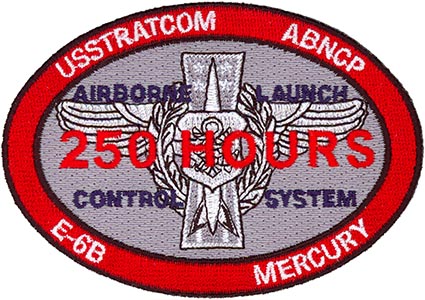
The airborne launch control system (ALCS) officer is the missile launch team leader and, along with the operations officer, operates the ALCS. This system allows Looking Glass to transmit launch codes to the intercontinental ballistic missiles in their underground silos should ground launch control centers become disabled. It qualifies the aircraft as a weapon system even though Looking Glass itself cannot fire a bullet or drop a bomb. The ALCS officer is also the intelligence planner and briefs the entire battle staff on current intelligence matters, develops threat assessments, and identifies emerging threats to the United States.
The Looking Glass has two command and control managers. The first, an emergency actions non-commissioned officer, is charged with knowing the formats, contents and appropriate wording for emergency action messages used to execute U S. war plans. The emergency actions non-commissioned officer and the mission commander form the emergency actions team. The second, the force status non-commissioned officer is an expert in force accounting procedures and accounts for and tracks every strategic weapon in the U.S inventory.
The logistics planners make sure that returning bomber and tanker forces have safe recovery bases that can provide medical attention, food, and rest for the crew and expeditious repairs, refueling, and reloading for the aircraft. The Meteorological and Oceanographic (METOC) support officer provides nuclear detonations effects analysis on areas of interest and provides information on weather and radioactive fallout effects.
The above battle staff personnel are part of the Global Operations Directorate, USSTRATCOM. The crew and aircraft are from Strategic Communications WING ONE, Tinker AFB, Okla. WING ONE also maintains a small detachment at Offutt AFB in support of the Looking Glass aircraft.
The crew consists of three pilots, a navigator, two flight engineers, an airborne communications officer, two communications operators, three in-flight technicians, and two trailing wire antenna operators.
After 46 years, SAC was deactivated on June 1, 1992, and USSTRATCOM was activated. Looking Glass became part of the command. Activation of USSTRATCOM coincided with a change from a bi-polar world to a multi-polar world in the wake of a dissolving Soviet Union. It also marked a transition for Looking Glass from an Air Force operation to a joint military mission. The basic mission remains unchanged. Looking Glass provides an around-the-clock, survivable, alternate command post for the commander of USSTRATCOM and the nation’s senior leadership, guaranteeing the use of strategic forces during national emergencies.
UNITED STATES STRATEGIC COMMAND
U.S. Strategic Command is one of eleven unified combatant commands in the Department of War, stationed at Offutt AFB, NE.
USSTRATCOM integrates and coordinates the necessary command and control capability to provide support with the most accurate and timely information for the President, the Secretary of War, other national leadership and combatant commanders.
The mission of USSTRATCOM is to conduct operations to deter strategic attack and employ forces, as directed, to guarantee the security of the nation and our allies. The command enables Joint Force operations and is the combatant command responsible for Strategic Deterrence, Nuclear Operations, Nuclear Command, Control, and Communications (NC3) Enterprise Operations, Joint Electromagnetic Spectrum Operations, Global Strike and Missile Threat Assessment.
USSTRATCOM combines the synergy of the U.S. legacy nuclear command and control mission with responsibility for global strike operations. This dynamic command gives national leadership a unified resource for greater understanding of specific threats around the world and the means to respond to those threats rapidly.
The Global Operations Center, or GOC, is the nerve center for USSTRATCOM. The GOC is responsible for the global situational awareness of the Commander, USSTRATCOM, and is the mechanism by which he exercises operational command and control of the Nation’s global strategic forces.
The missions of U.S. Strategic Command are to deter attacks on U.S. vital interests, to ensure U.S. freedom of action in space and cyberspace, to deliver integrated kinetic and non-kinetic effects to include nuclear and information operations in support of U.S. Joint Force Commander operations, to synchronize global missile defense plans and operations, to synchronize regional combating of weapons of mass destruction plans, to provide integrated surveillance and reconnaissance allocation recommendations to the SECDEF, and to advocate for capabilities as assigned.
Component Structure: JFCC – Global Strike (JFCC-GS) Offutt AFB, NE, conducts kinetic (nuclear and conventional) and non-kinetic effects planning. GS manages global force activities to assure allies and to deter and dissuade actions detrimental to the United States and its global interests; should deterrence fail, employs global strike forces in support of combatant commander.
JFCC – Space (JFCC-SPACE) Vandenberg AFB, CA, continuously coordinates, plans, integrates, commands and controls space operations to provide tailored, responsive, local and global effects, and on order, denies the enemy the same, in support of national, USSTRATCOM, and combatant commander objectives.
JFCC – Network Warfare (JFCC-NW) Fort Meade, MD, plans, and when directed, executes operations in and through cyberspace to assure US and allied freedom of action, denying adversaries’ freedom of action, and enabling effects beyond the cyber domain.
Joint Task Force-Global Network Operations (JTF-GNO) Arlington, VA, directs the operation and defense of the Global Information Grid to assure timely and secure Net-Centric capabilities across strategic, operational, and tactical boundaries in support of Department of Defense full spectrum warfighting, intelligence, and business missions.
JFCC – Integrated Missile Defense (JFCC-IMD) Schriever AFB, CO, synchronizes operational-level global missile defense planning, operations support, and the development of missile defense effects for DoD. When directed, also provides alternate missile defense execution support.
JFCC – Intelligence, Surveillance and Reconnaissance (JFCC-ISR) Bolling AFB, Washington, D.C. identifies and recommends appropriate resources to meet high priority intelligence requirements. Essentially, ISR helps ensure the best use of resources to provide decision makers and troops with crucial information when and where they need.
Joint Information Operations Warfare Command (JIOWC) Lackland AFB, TX, uses information as a tool to change attitudes or perceptions, creating desired results. Information Operations tactics help protect United States interests while disrupting the adversary’s capabilities.
USSTRATCOM Center for Combating Weapons of Mass Destruction (SCC-WMD) Fort Belvoir, VA, provides the Defense Department with expertise in contingency and crisis planning to interdict and eliminate the proliferation or use of Weapons of Mass Destruction.