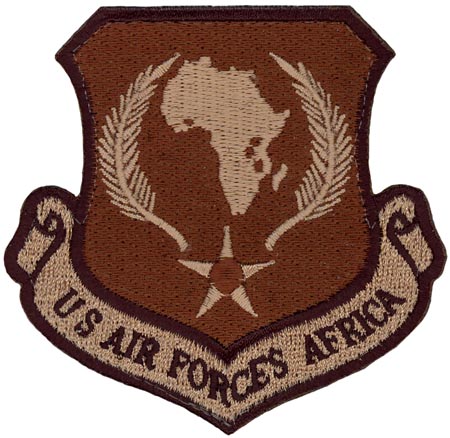
Description
Computer made/mounted on velcro 3.0 inch-77mm
United States Africa Command
United States Africa Command, AFRICOM, one of six of the Defense Department’s regional military headquarters, was declared a fully unified command on October 1, 2008. As such, Africa Command has administrative responsibility for U.S. military support to U.S. government policy in Africa, to include military-to-military relationships with 54 African nations. The other five regional commands and their locations are: U.S. Central Command, Tampa, Florida; U.S. European Command, Stuttgart, Germany; U.S. Northern Command, Colorado Springs, Colorado; U.S. Pacific Command, Honolulu, Hawaii; and U.S. Southern Command, Miami, Florida.
Chain of Command: The commander of Africa Command reports to the U.S. Secretary of Defense, who reports to the President of the United States. In individual countries, U.S. Ambassadors continue to be the President’s personal representatives in diplomatic relations with host nations.
AFRICOM Mission: Africa Command protects and defends the national security interests of the United States by strengthening the defense capabilities of African states and regional organizations and, when directed, conducts military operations, in order to deter and defeat transnational threats and to provide a security environment conducive to good governance and development.
Listening to Our African Partners: U.S. Africa Command values the views of our African partners and learns from them. Our partners have expressed four common defense-oriented goals consistent with American interests and the Command’s theater objectives. These goals are:
•That they have capable and accountable military forces that perform professionally and with integrity;
•That their forces are supported and sustained by effective, legitimate, and professional security institutions;
•That they have the capability to exercise the means nationally and regionally to dissuade, deter, and defeat transnational threats, and;
•That they have the capacity to increase their support to international peacekeeping efforts.
U.S. Africa Command’s theater strategic objectives: U.S. AFRICOM supports U.S. national security interests by conducting a wide range of programs and activities that help African states and regional organizations–at their request–meet their security and defense goals. Our strategic objectives are:
•Ensure that the al-Qaida networks and associated violent extremists do not attack the United States;
•Maintain assured access and freedom of movement throughout our AOR;
•Assist African states and regional organizations in developing the will, capability, and capacity to combat transnational threats such as terrorism, piracy, and the illicit trafficking of weapons, people, and narcotics;
•Assist African states and regional organizations in developing the capacity to execute effective continental peace operations and to respond to crises, and;
•Encourage African militaries to operate under civilian authority, respect the rule of law, abide by international human rights norms, and contribute to stability in their respective states.
Personnel: As of April 2011, U.S. Africa Command has approximately 2,100 personnel. This includes approximately 1,500 personnel at Kelley Barracks in Stuttgart, Germany; approximately 400 personnel at RAF Molesworth, U.K.; approximately 50 personnel in Tampa, Fla.; and approximately 100 personnel (half of whom are local national employees) with Offices of Security Cooperation (OSC) in African host nations. The U.S. Africa Command staff is about half military and half civilian employees of the Department of Defense, plus approximately 40 civilian employees of non-Defense Department agencies of the U.S. government; as well as approximately 300 contracted employees in Germany, the United Kingdom, and Florida.
Location: U.S. Africa Command is located at Kelley Barracks in Stuttgart-Moehringen, Germany. U.S. Africa Command is not actively seeking any other headquarters locations. The command’s focus is on working with U.S. Embassies and African partner nations and organizations to strengthen existing military-to-military relationships. The command’s programs in Africa are coordinated by approximately 18 Offices of Security Cooperation. Located in U.S. Embassies, OSC staffs typically include one to three people. The command plans to add seven more OSCs in Fiscal 2012. The command also has liaison officers at key African posts, including the African Union, the Economic Community of West African States (ECOWAS), and the Kofi Annan International Peacekeeping and Training Centre in Ghana.
Funding: U.S. Africa command received $274 million in Fiscal Year 2010. The Obama administration has requested $298 million for the command for Fiscal Year 2011.
Key dates:
October 3, 1983: U.S. European Command becomes responsible for U.S. military relations with sub-Saharan Africa with the exception of the Horn of Africa. U.S. Pacific Command is responsible for Indian Ocean island nations.
February 6, 2007: President Bush and Secretary of Defense Robert Gates announced the creation of U.S. Africa Command.
October 1, 2007: U.S. Africa Command formally began initial operations, with the goal of building the headquarters over the next year and preparing the staff to assume responsibilities for U.S. military-to-military relationships in Africa. General William E. “Kip” Ward is named as the first AFRICOM commander.
October 1, 2008: U.S. Africa Command became an independent Unified Combatant Command, assuming responsibility for U.S. military relationships, programs and activities in Africa.
March 9, 2011: General Carter F. Ham succeeds Ward as U.S. AFRICOM commander.
Supporting the U.S. Department of State: U.S. Africa Command supports the U.S. Department of State in the achievement of US foreign policy objectives in Africa. In addition and where appropriate, U.S. Africa Command provides personnel and logistical support to State Department-funded activities. Command personnel work closely with U.S. embassies in Africa to coordinate training programs to improve African nations’ security capacity.